Stacks of coins placed beside a fluctuating graph line, symbolizing real estate investment and pricing variations based on built-up, super built-up, and carpet area calculations.

What is Built Up Area vs Super Built Up Area vs Carpet Area: Explained

In India, an individual desiring to buy a property must know how area measurement works. The terms Carpet Area, Built-Up Area, Super Built-Up Area, and RERA Carpet Area are commonly used in property listings but confuse most buyers.

Understanding the difference between these can help you make the right choice. This way, you make an informed decision and avoid overpaying. Plus, making the entire transaction process transparent to all concerned parties. 

Importance of Understanding Property Areas

Wrong measurements always influence the price, usability, and legal standing of the property. Hence, if a buyer is not well aware, they can end up paying for space they legally cannot use. Therefore, an understanding of property areas is crucial so that:

  1. a) Price comparisons can be made on an equal footing
  2. b) The entire process is under RERA and thereby legally compliant
  3. c) High transparency in agreements between builders and buyers
  4. d) Make an investment decision

The Overview of Real Estate Terms

Carpet Area – The actual usable area within the walls.

Built-Up Area – Carpet area plus internal walls and balcony.

Super Built-Up Area – Built-up area plus proportionate common spaces.

RERA Carpet Area – Carpet area as defined legally under the RERA Act 2016.


What is a Carpet Area?

Carpet Area refers to the area in an apartment or building that the occupant can use. Here, the reference is taken from the word carpet, as a carpet can be laid in this area. As per the Real Estate (Regulation and Development) Act, 2016, Carpet Area means the net usable floor area of an apartment, excluding the area covered by the external walls, balcony or verandah, and open terrace.

 It is the usable area of the house where you can practically put furniture, walk, or perform daily tasks.

Components Included

Usually, the carpet area includes:

  • Living room
  • Dining area
  • Bedrooms
  • Kitchen
  • Bathrooms and toilets
  • Study rooms or other usable rooms
  • Internal partition walls (within the flat)

It includes all the floor area that is usable and is inside the apartment’s internal walls.

Components Excluded

The following components are excluded from the carpet area:

  • External walls
  • Balconies and verandahs
  • Terraces (private or common)
  • Utility ducts or shafts
  • Common areas like staircases and lobbies
  • Parking spaces

Thus, it is different from built-up and super built-up areas, which do cover some or all of the above areas.

How to Calculate?

  • Measurement of the length and breadth of each usable room (including kitchen, bedrooms, and bathrooms)
  • Multiply length by breadth to get the area of each of the rooms.
  • Determine the total carpet area by adding all the areas.

Mathematically:

Carpet Area = Sum of all usable room areas (within internal wall)


What is Built Up Area?

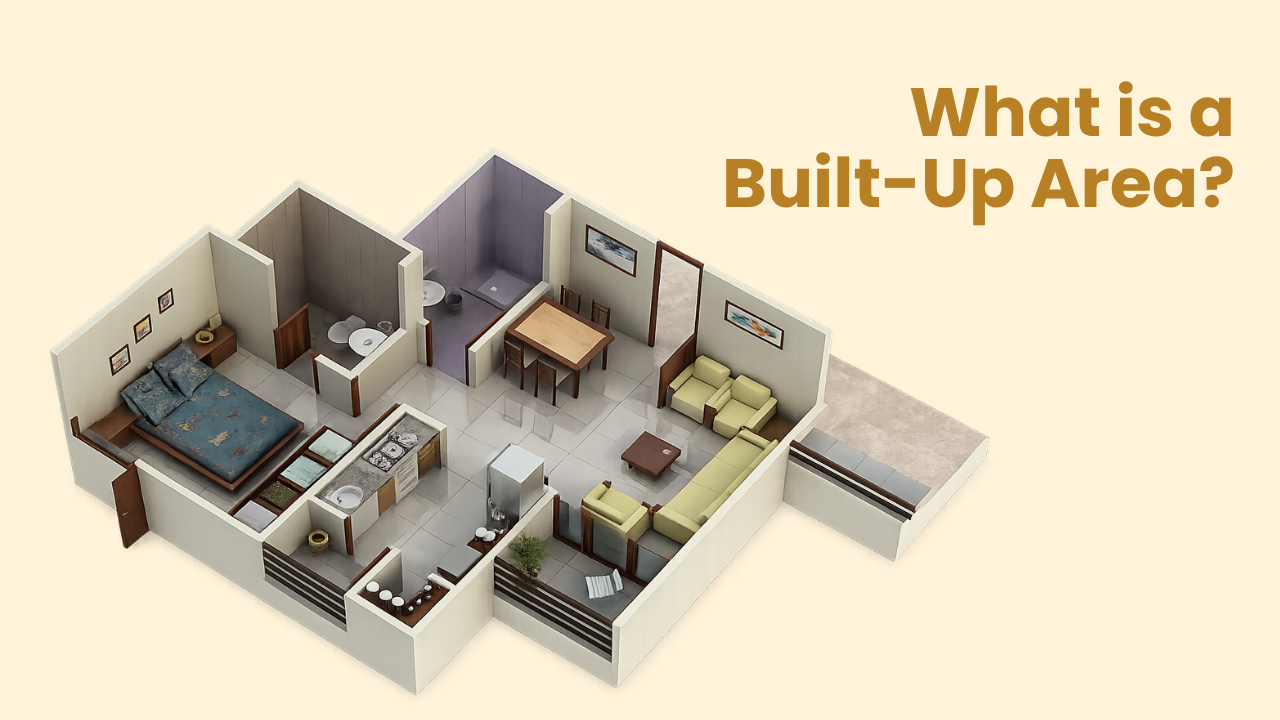
3D apartment floor plan showing rooms, walls, balcony, and utility spaces explaining what is built up area in real estate including total constructed space of a flat

The term built-up area refers to the complete area of a flat. This consists of the carpet area, the thickness of internal and external walls. It also includes certain additional areas like balconies and utility spaces. Thus, from the built-up area, one can safely infer it is the total constructed area of the unit and is always more significant than the carpet area.

Building-Up Components Included

Typically, the built-up area accounts for:

  • Carpet area (the usable space within the flat)
  • Thickness of internal walls
  • Thickness of external walls
  • Balcony and verandahs (private)
  • Utility areas (washing area, service balcony)

Note: Common areas of the property, such as staircases, lobbies, lifts, or clubhouses, are not included in the built-up area. Those areas are covered by the super built-up area.

Calculation Formula

  • Built-Up Area Calculation= Carpet Area + Wall Area + Balcony + Utility Area
  • In the absence of an exact measurement, builders resort to an approximate method, as follows:
  • Built-Up Area ≈ Carpet Area + 10% to 25%
  • This percentage varies in keeping with architectural design, wall thickness, and method of laying out a project.

Typical Percentage Increase Over Carpet Area

A built-up area is usually between 10% and 25% more than the carpet area. The amount varies depending on:

  • Wall thickness (thicker walls = higher difference)
  • Number and surface area of balconies
  • Inclusion of ducts and service areas

Example:

  • Carpet area: 800 sq. ft.
  • Walls + Balconies + Utility areas: 160 sq. ft. (20% of carpet area)
  • Built-Up Area = 960 sq. ft.

What is Super Built Up Area?

Definition

In simple terms, the super built-up area is the total saleable area of a property. It includes the built-up area and a share of common areas in a residential complex. 

Components Included

The super built-up area consists of:

  • Carpet Area
  • Wall thickness (internal and external)
  • Balconies and utility areas

Proportionate share of common areas like:

  • Staircases
  • Lobbies and corridors
  • Lift shafts
  • Clubhouse
  • Swimming pool
  • Garden pathway
  • Security room
  • Other amenities

In some cases, it also encompasses the share of commercial amenities or community halls, for whose use one may never pay.

Calculation Formula

No one fixed formula, and the most commonly used amongst them is:

Super Built-Up Area = Built-Up Area + (Common Area × Proportionate Share)

OR

Super Built-Up Area = Carpet Area × (1 + Loading Factor)

Where Loading Factor is a multiplier used by the builder to account for common areas.

About Loading Factor

This factor, expressed as a percentage, denotes how much extra area beyond carpet area is being charged for common areas.

Formula:

Loading (%) = [(Super Built-Up Area − Carpet Area) ÷ Carpet Area] × 100

Loading range:

Budget projects: 20% – 30%

Mid-range apartments: 30% – 40%

Luxury projects with large rehab areas: 40% – 60%

Example:

So, Laxmi Sky City, a new project of 3 and 4 BHK flats

Carpet Area: 750 sq. ft.

Built-Up Area that includes balconies and internal walls: 900 sq. ft.

Super Built-Up Area that includes shared stairways and landing, and other shared amenities: 1125 sq. ft.

Here, the loading factor is down to the 50 per cent mark, which is typical for almost all compatibles. Also, try to always get a breakdown from Laxmi Group so that you know what you are paying for.

Why It Matters

Misleading Pricing: Quoting rates on super built-up area may make a property cheaper per sq. ft., but on the usable sq. ft., you pay more.

Transparency Under RERA: RERA discourages its use of super built-up area in contracts and requires clear disclosure of carpet area.

Smart Buying: Get a detailed breakdown of areas and base your comparison on carpet area for a worthy evaluation.

What is RERA Carpet Area?

Definition: According to the Act of RERA, 2016

If one goes by the Real Estate (Regulation and Development) Act, 2016 (RERA), Carpet Area means:

“The net usable floor area of an apartment, excluding the area covered by the external walls, areas under service shafts, exclusive balcony or verandah area, and exclusive open terrace area, but includes the area covered by internal partition walls of the apartment.”

This legal definition brought about standardisation and transparency across the Indian real estate sector so that all builders would disclose the same kind of area, namely, usable area only.

Difference Between RERA Carpet and Actual Carpet

Here is the difference between RERA Carpet  and Actual Carpet:

Aspects Actual Carpet Area RERA Carpet Area
Internal partition walls Sometimes excluded Included
External walls Excluded Excluded
Service ducts Not clearly defined Excluded
Balconies / verandahs Sometimes included Excluded
Usable definition Vague or builder-defined Legally defined

Importance of RERA Carpet Area

Standardisation: Transparency will improve as all developers will now need to follow one legal definition.

Accurate Pricing: Buyers pay for what they use, not for an overstated super built-up area.

Legal recourse: Buyers can take legal action if the actual carpet area differs from the promised RERA carpet area.

Better Comparisons: Consumers now have easier and more equitable methods to compare properties across developers.

Comparative Analysis

Tabular Comparison: Difference between Actual Carpet Area and RERA Carpet Area vs Built-Up Area vs Super Built-Up Area

Features / Criteria Carpet Area Built-Up Area Super Built-Up Area RERA Carpet Area
Includes internal partition walls ✅ Yes ✅ Yes ✅ Yes ✅ Yes
Includes external walls ❌ No ✅ Yes ✅ Yes ❌ No
Includes balconies / verandahs ❌ No ❌ No ❌ No ❌ No
Includes shared / common areas ❌ No ❌ No ✅ Yes ❌ No
Defined by law ❌ No ❌ No ❌ No ✅ Yes (RERA)
Standard across developers ❌ No ❌ No ❌ No ✅ Yes
Reflects actual usable space ✅ Yes Partially ❌ No ✅ Yes

Example: 

Laxmi Courtyard (2 BHK Flat)

Carpet Area: 710 sq. ft.

Its Built-Up Area is: 860 sq. ft.

Super Built-Up Area: 1075 sq. ft.

Loading Factor:

(1075 − 710/ 710) ×100 ≈ 51.4%

Insight: Being positioned in the deluxe middle segment, Laxmi Courtyard includes common facilities such as a landscaped garden, clubhouse, and broad corridors, all contributing to a somewhat higher loading percentage.

How to calculate each area? 

Step-Wise Procedure

Carpet Area

  • Measure the internal dimensions of all usable rooms.
  • Calculate area by length × width.
  • Add together the areas of all rooms, including the kitchen and bathrooms.
  • Consider internal partition walls.

Built-Up Area

  • Start from the carpet area.
  • Add the thickness of external walls.
  • Include balconies, utility, and service zones (if applicable).

Super Built-Up Area

  • Start from the built-up area.
  • Add a proportionate share of common areas.


Use an Online Calculator

To avoid mistakes when calculating the building area, buyers can use property area calculators. These are available on real estate websites and apps like:

MagicBricks Carpet Area Calculator

Housing.com`s Area Converter

RERA Carpet Area (for approved projects)

Thus, they input the carpet area or super-built area and the loading percentage and get the quick output.

Practical Examples

Imagine buying a flat in Laxmi Eternia (3 BHK Flat)

Carpet Area: 960 sq. ft.

Built-Up Area: 1150 sq. ft.

Super Built-Up Area: 1400 sq. ft.

Loading Factor:

(1400 − 960/ 960) × 100 ≈ 45.8%

Laxmi Eternia is for buyers wanting to live spaciously in a gated community high-rise. Premium amenities such as a gym, amphitheatre, and dedicated kids’ play zones suitably cater for the moderate loading factor

Effect on Property Pricing

Pricing Based on Different Area Types

Builders tend to apply their price per square foot on the Super Built-Up Area, while the buyers expect it for the carpet area. This fact leads to confusion among the buyers about the real worth they get.

Let’s have an example:

  • Quoted price: ₹5,000/sq. ft. (on SBA)
  • SBA=1200 sq. ft.
  • Actual usable-(i.e., Carpet)=800 square feet
  • Effective Cost per Carpet Area: ₹7,500/square feet

Importance for Buyers

Usable Space Clarity: The price may seem low based on the super built-up area. Buyers should check the price per carpet area to understand the real value.

Better Budgeting: Knowing the area layout can help estimate the costs of furniture and utilities.

Smart Comparison: While comparing two flats, use the carpet area and total price and do not go by the per sq. ft. rate.

How Construction Quality Affects Usable Level

Poor construction can greatly reduce usable space, even if someone smartly calculated carpet area calculations on paper. Here: 

  • Wasteful or old-fashioned designs can cause thick walls, which can minimise the room size.
  • The intentional alignment of columns, beams, and doorways can limit the functional organisation of spaces.
  • Kitchens and bathrooms can utilise additional floor space as a result of inadequate duct and plumbing design.
  • Service shafts or maintenance shafts may occupy a corner of a room and hence limit the position of furniture.

| Hint: Area sizes (carpet area, instance) don’t reveal the full story. Looking at the plot or examining floor plans might help with estimates of room size.

Influence of Vastu on Space Utility and Design Compliance  

Vastu plays an important role for Indian homebuyers and potentially influences space utilisation:

  • Vastu might require designs to have rooms of asymmetrical or awkward-shaped form that are contained within directional guidelines.
  • Additional space reserved at corners for Vastu purposes can become inaccessible.
  • Forced north or east-facing kitchens or obligatory entrances might create awkward internal plans.

| Tip: Opt for a design that adequately takes Vastu principles into account without sacrificing space planning for usability. Particularly so where space usability is concerned. 

Vastu Trends in Ahmedabad Homes

In Gujarat, particularly in Ahmedabad, Vastu Shastra still governs residential planning. Some of the popular buyer choices are:

  • North-East Entrance: Being deemed auspicious, most of the customers prefer northeast-facing apartments.
  • East-facing kitchens are thought to be healthy and wealthy, particularly in the case of joint families.

How to Avoid Overpaying on Area Measurement

Purchase cost can be misleading when the builder quotes on super built-up area rather than on usable carpet area. Here’s how the smart buyers should avoid paying more.

Demand Carpet Area Pricing

Always insist on a per-square-foot price based on RERA Carpet Area and never on Super-Built-Up Area pricing.

Keep a Watch on Loading Factor

Too high a loading factor (more than 40%) and you could be made to pay extra for common area features. Set this against other projects.

Demand Area-wise Breakup

Get an area-wise breakup of Carpet, Built-Up, and Super-Built-Up Areas. This should come in the builder’s literature.

Online Area Calculators

Online tools, offered by MagicBricks and Housing.com, can be used to check one’s area and price.


Frequently Asked Questions (FAQs)

1. What is the most important type of area that buyers consider?

Carpet Area, meaning the area usable inside the flat.

Yes, since it serves the usable part of the house, so it counts in the carpet area.

Anything between 20% and 30% loading factor is a reasonable idea. But anything beyond 40% is generally less for your usable area.

Indeed, this is why it’s important to compare the carpet area instead of only the super built-up.

Check out the layout plan registered with RERA, showing exact measurements. Also, you may request a layout properly approved by your local development authority. 

RERA Carpet Area means the carpet area of a flat, within the internal walls but not including the balconies, terraces, exterior walls, and common areas. It is determined by adding the floor area of all the rooms in the flat.

Apply For Job

Inquire Now