




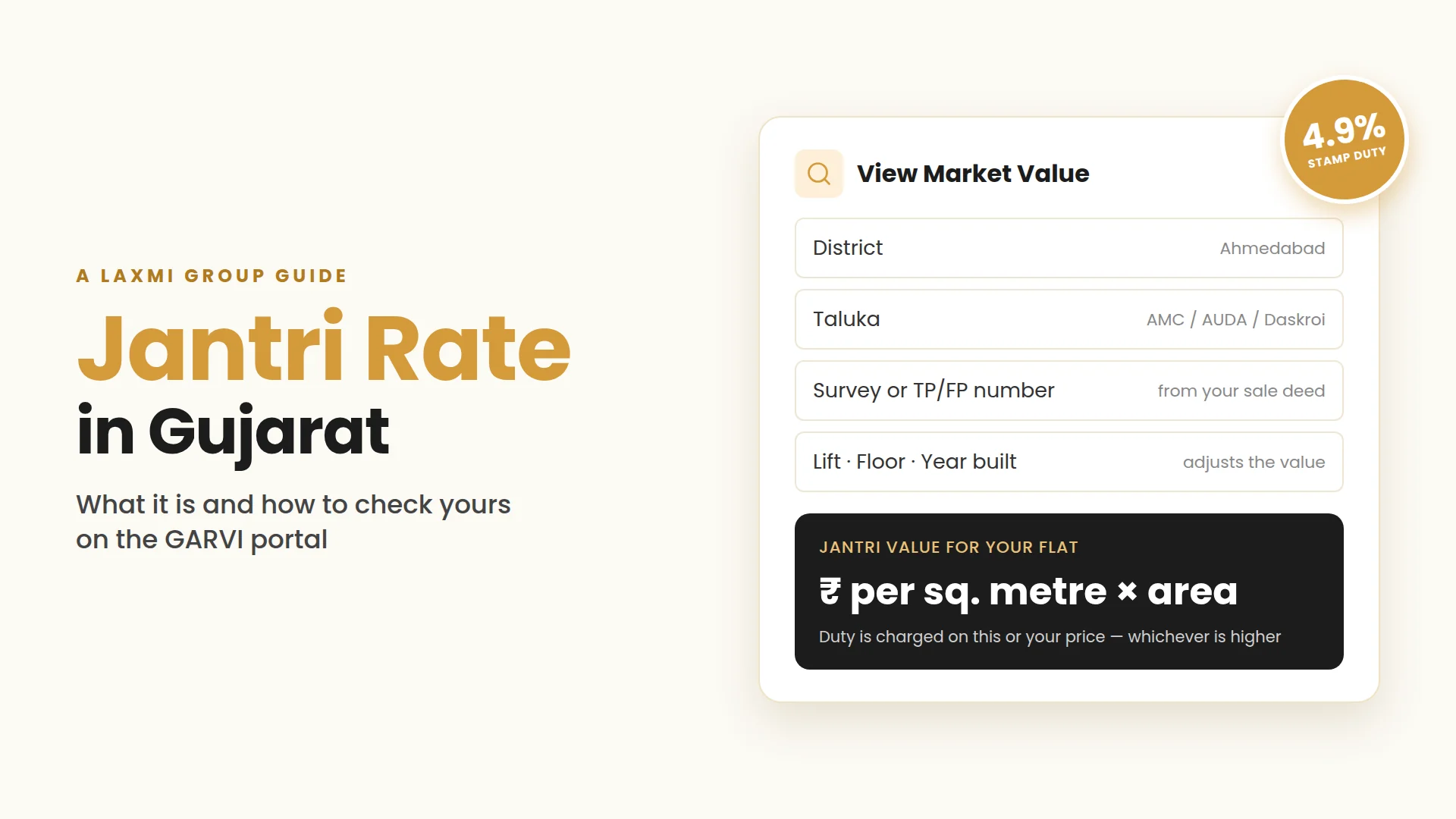
You agreed a price. You budgeted the stamp duty on that price. Then, a week before registration, someone says the duty will be worked out on the jantri value instead — and nobody tells you what that is or where to find it.
It takes about five minutes to look up. Here is exactly how, and what it does to your bill.
A jantri rate is the Gujarat government’s minimum official value for a property. Stamp duty and registration are charged on the higher of two numbers: your agreement price, or the jantri value. You can look yours up free on the state’s GARVI portal. The rates in force today took effect on 15 April 2023.
Key Takeaways
- Jantri is a floor, not a price. If your agreement value is higher, you pay duty on your agreement value. If it is lower, you pay on the jantri value.
- The link most people land on is dead. The page Google ranks first for checking jantri online returns a 404 error. The working page is on the GARVI portal under View MarketValue — not under the word “Jantri”.
- You need your survey number. Without the survey or TP/FP number from your sale deed, the lookup returns nothing.
- Your flat’s jantri is not your area’s jantri. The portal adjusts the value for your floor, whether the building has a lift, the construction stage and the year built.
- New rates are drafted but still not in force. A 2024 draft drew over 11,000 objections and has been deferred. Until it is notified, the April 2023 rates apply.
What’s on this page
- What is a jantri rate in Gujarat?
- How to check your jantri rate online
- Why your flat’s jantri is not your area’s jantri
- Which taluka to choose if you are in Ahmedabad
- What the jantri rate costs you on registration day
- Jantri rate vs market price
- Are new jantri rates coming in Gujarat?
- Checking the jantri rate on a Laxmi project
- Frequently asked questions
What Is a Jantri Rate in Gujarat?
A jantri rate is the lowest value the Gujarat government will accept for a property. Its formal name is the Annual Statement of Rates, often shortened to ASR. The Revenue Department sets it through the Superintendent of Stamps, and it is published on the state’s GARVI portal.
It exists to stop under-reporting. If buyers and sellers could write any number they liked on a sale deed, they would write a small one and pay less tax. So the state fixes a floor for every location and every kind of property, and charges duty on whichever is higher — the price in your agreement, or the jantri value.
These values are quoted per square metre. Other states call the same thing a circle rate, a ready reckoner rate or a guidance value. In Gujarat it is jantri.
One thing to be clear about: jantri is not what your flat is worth. It is a tax floor. In most parts of Ahmedabad the real market price sits well above it. More on that further down.
How to Check Your Jantri Rate Online
The lookup is free, takes about five minutes, and needs no login. But two things trip almost everyone up, so read the warning first.
⚠ Two Traps Before You Start
1. The top search result is a broken page. Search “jantri rate online” and the first result is usually garvi.gujarat.gov.in/ViewJantri_New. That page returns a 404 error. We checked it again on 24 October 2026. Go to the GARVI home page instead.
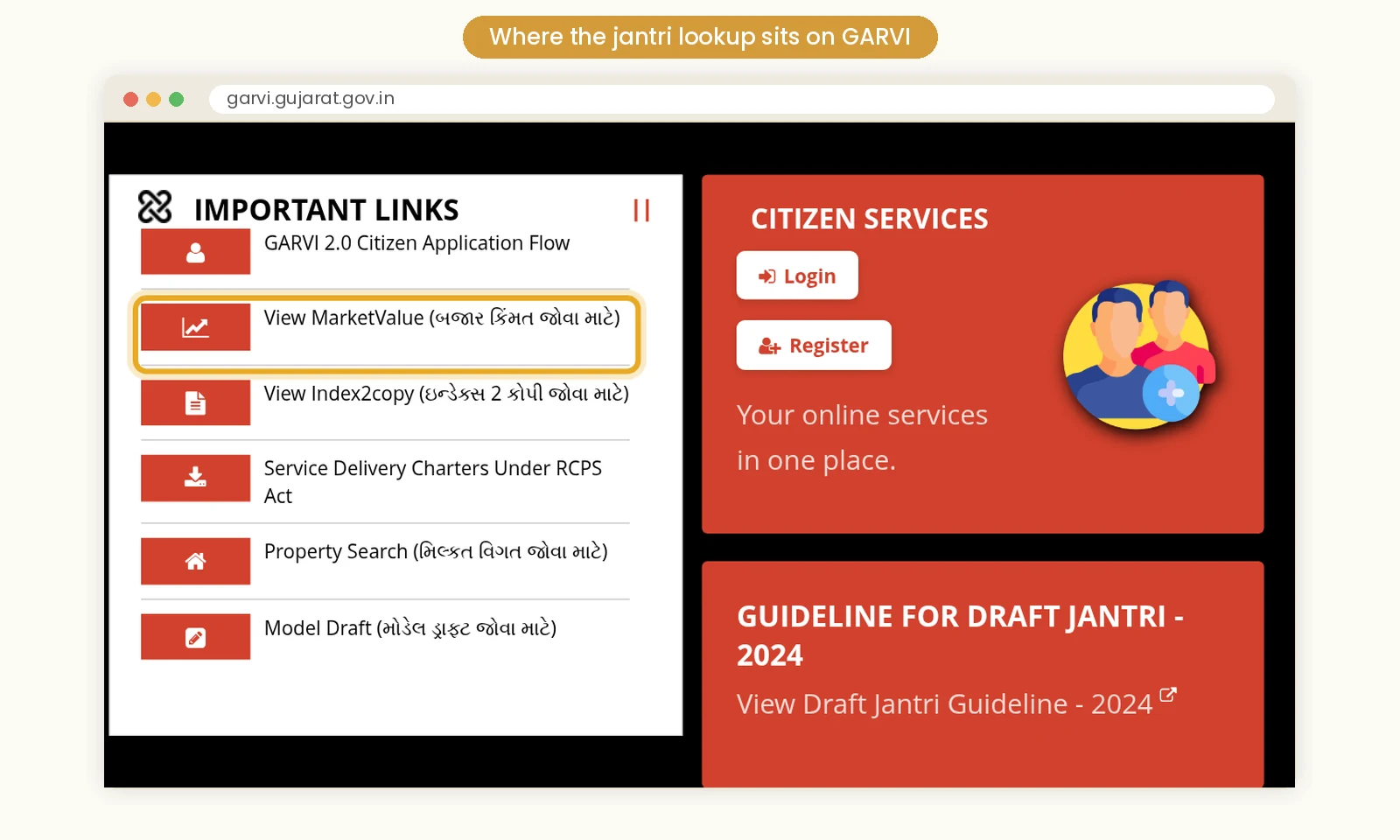
2. The link is not called “Jantri”. On the GARVI home page, look under Important Links for “View MarketValue” (in Gujarati, બજાર કિંમત જોવા માટે). That is the jantri lookup. You can also reach it from Online Services → Property Valuation.
What to Keep Ready
You cannot browse your way to a number. The portal works off a specific piece of land, so you need the identifier for yours:
- Your survey number, or your TP/FP number (town planning and final plot number) for city land.
- Which authority your property falls under — the municipal corporation, the urban development authority, or the taluka.
- The built-up area in square metres, the floor your flat is on, and the year the building was finished.
All of this sits on your sale deed, your 7/12 extract or your property card. If you are buying a new flat, the builder’s office can give you the survey or TP/FP number in a minute — it is a fair thing to ask for, and it is on the same paperwork you use to check a project’s RERA status.
The Seven Steps
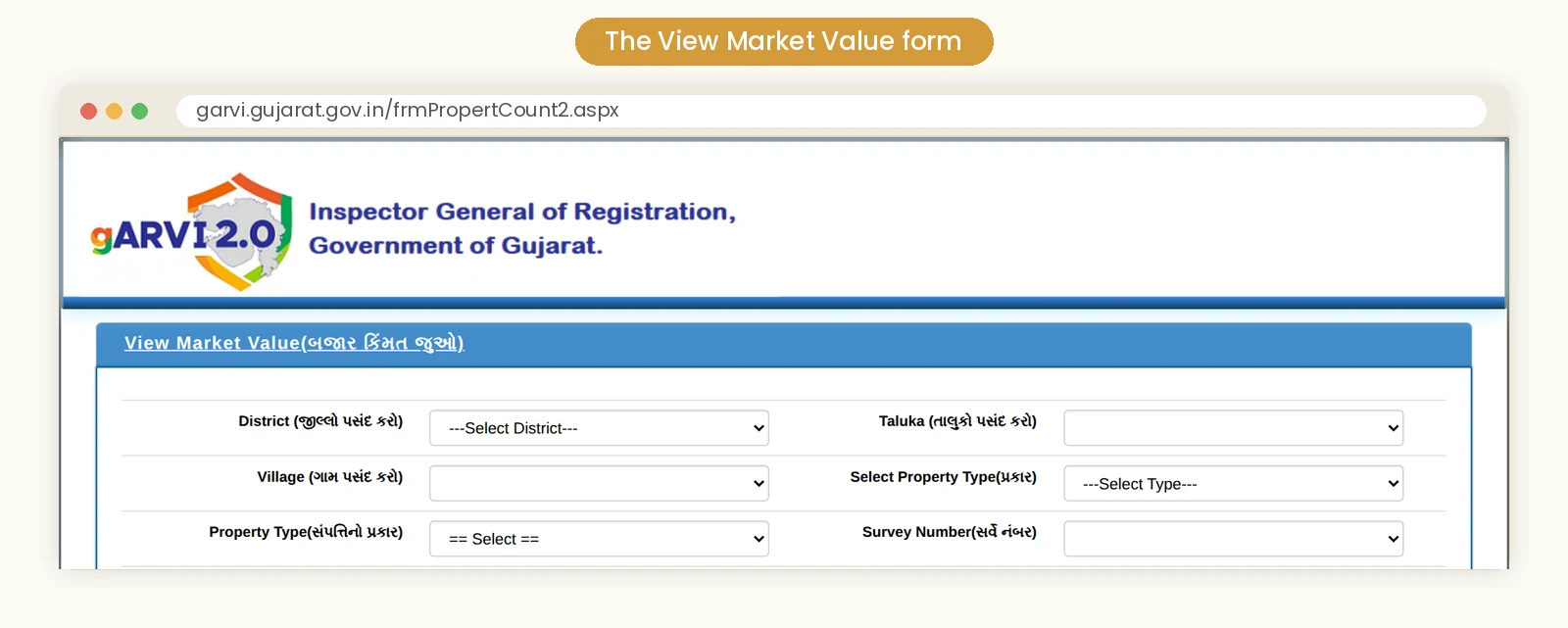
- Open the GARVI portalGo to garvi.gujarat.gov.in. Under Important Links, click View MarketValue. The page that opens is titled “View Market Value”.
- Choose your districtPick from the 34 districts in the list — Ahmedabad, Gandhinagar, Surat, Vadodara, Rajkot and the rest.
- Choose your talukaThis is the step people get wrong. The list mixes real talukas with administrative bodies. For Ahmedabad you will see AMC, AUDA – TP and AUDA – REVENUE sitting next to Daskroi, Dholka, Sanand and Bavla. See the table below for which to pick.
- Choose your village or areaThe list reloads based on the taluka you picked.
- Choose how the land is recordedThe options are T.P/F.P-URBAN, City Survey-URBAN, Survey-URBAN, Block-URBAN and RURAL. Match this to whatever number your papers actually carry. Get it wrong and the next list will be empty.
- Say what the property isPick from Residential – Flat / Apartment, Residential – Tenement / Row House / Bungalow, Commercial – Shop, Commercial – Offices, Non-Agriculture Land (Open Plot), the two industrial options, or agricultural land. A flat and a shop on the same plot are valued differently.
- Pick your survey number, fill in the details, then click Show MarketValueChoose your survey number from the list, then enter the area, the construction stage, whether there is a lift, whether it is the top floor, and the year built. Type the captcha code shown and press Show MarketValue. The portal returns the jantri value for that specific property.
If the result comes back blank, the usual cause is a mismatch at step 5 — the land is recorded differently from the option you chose. The state’s helpdesk is (079) 23277200.
Why Your Flat’s Jantri Is Not Your Area’s Jantri
This is the part almost every guide skips, and it matters.
You will find plenty of pages listing rates for Ahmedabad area by area — so much for Bodakdev, so much for Maninagar. Treat those as rough orientation only. The portal does not work at area level. It resolves down to a survey number, and then adjusts the figure for the specific property.
Look at what the form actually asks for after you have picked the location:
| Construction stage | Finished construction, incomplete with slab, or incomplete without slab |
|---|---|
| Lift | With lift or without lift |
| Floor | Top floor or not the top floor |
| Year built | Asked separately for the ground, first, second and third floors, the mezzanine and the basement |
| Road frontage | For shops only — whether the unit faces the road |
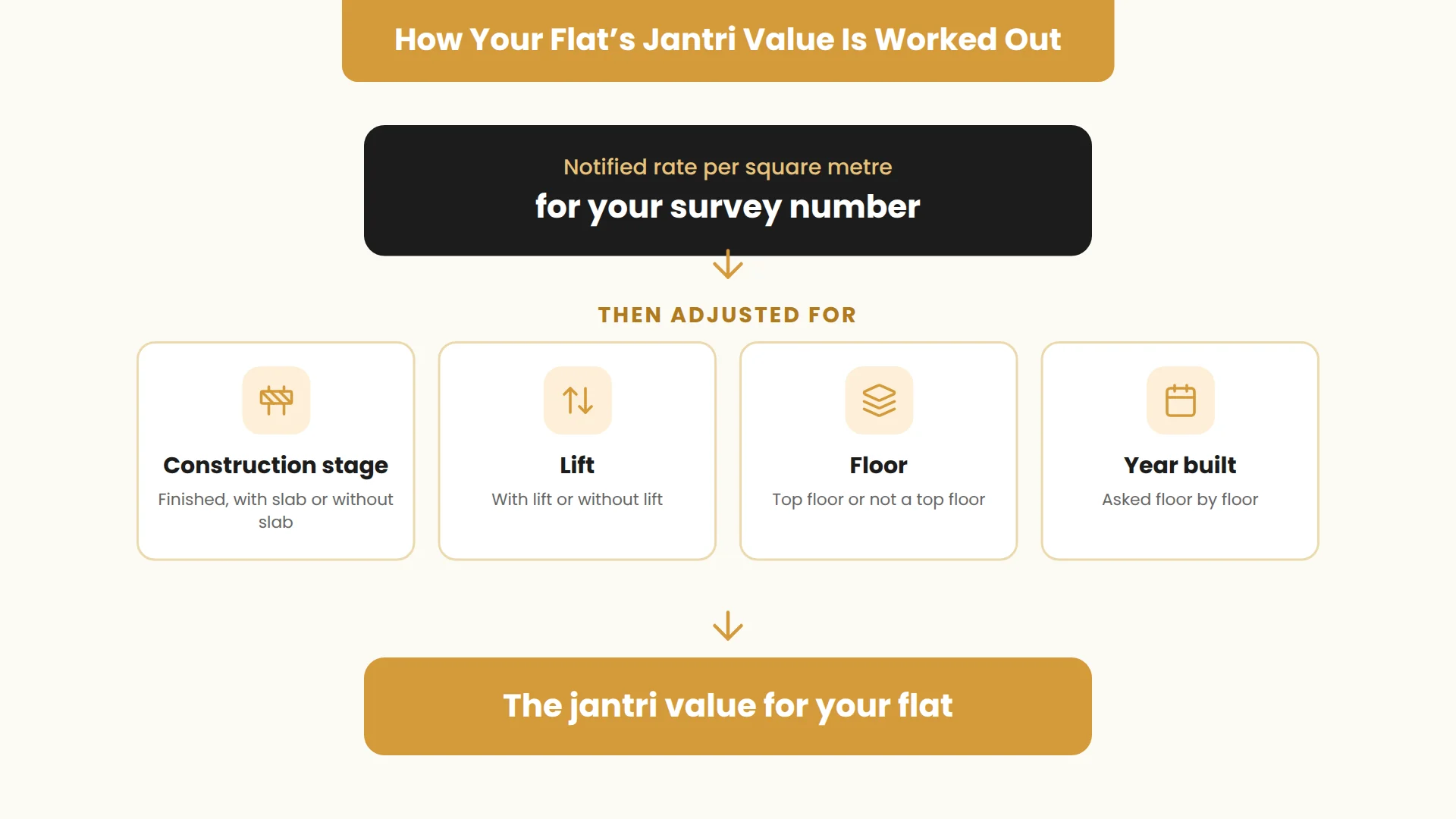
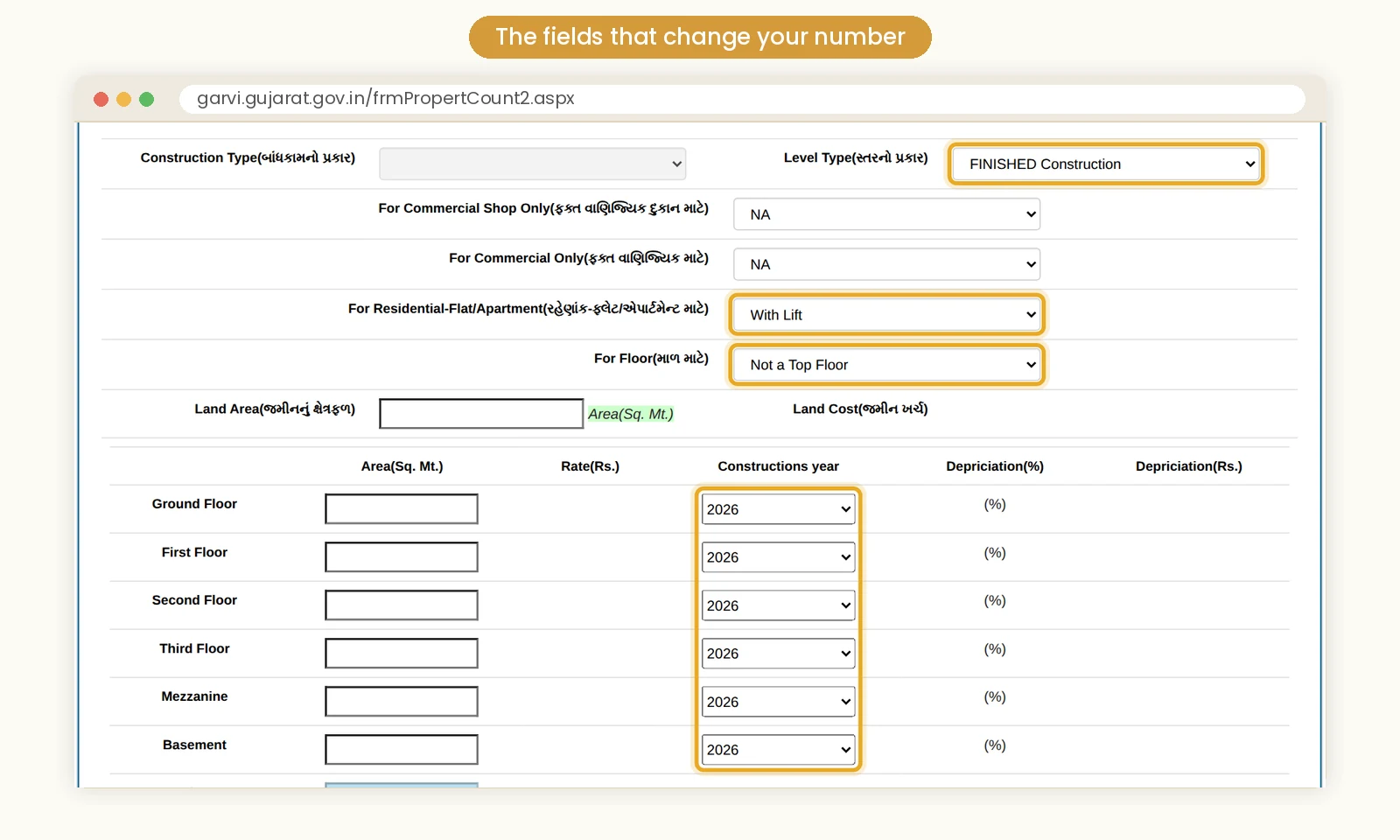
So two flats in the same building can carry different jantri values. A top-floor flat in a building without a lift is not valued the same as a second-floor flat in one with a lift. An older building is not valued the same as a new one.
The practical upshot: look up your own flat. Do not budget from a table you found on a blog — including, honestly, any table we could publish here. The only number that counts is the one the portal returns for your survey number.
Which Taluka to Choose If You Are in Ahmedabad
Looking up a jantri rate in Ahmedabad is harder than anywhere else in the state, because the taluka list mixes the municipal corporation, the urban development authority and the old revenue talukas. Here is where the city’s main residential belts usually sit.
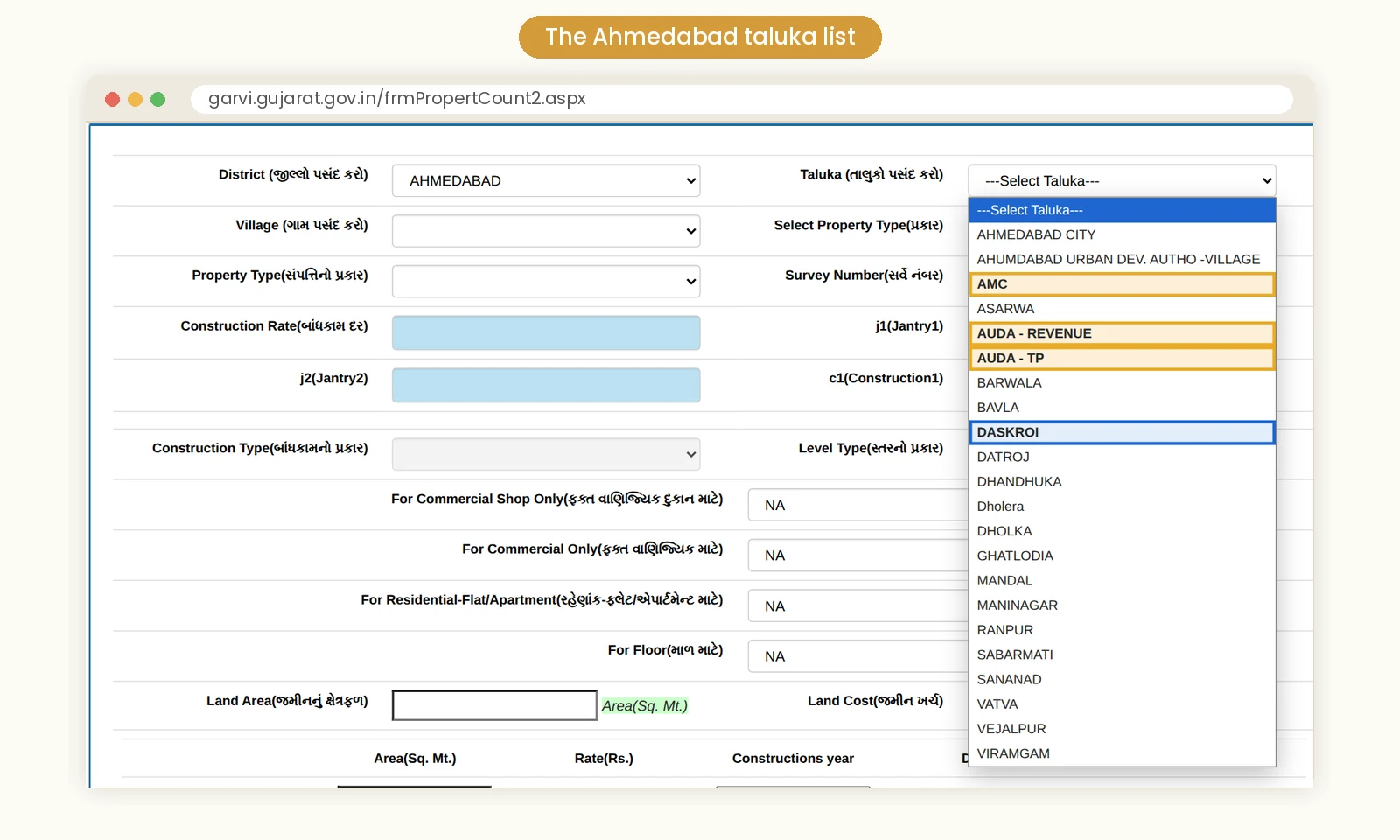
| Locality | Try this taluka entry first | If that is empty, try |
|---|---|---|
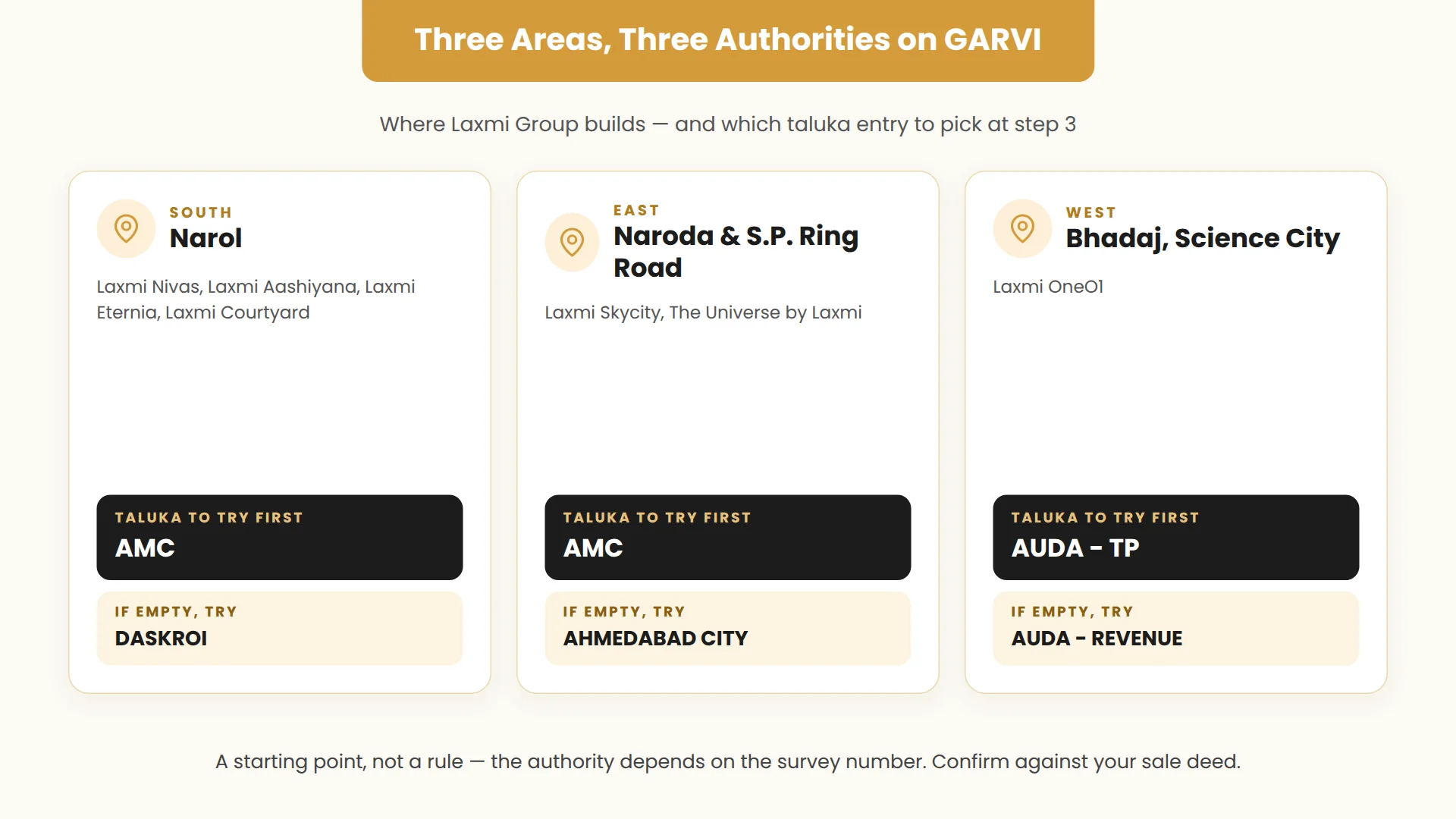
| Narol, Narol–Aslali belt | AMC | DASKROI → ASLALI |
| Naroda, Nava Naroda | AMC | AHMEDABAD CITY |
| Nikol, Vastral, Hathijan | AMC | DASKROI |
| Bhadaj, Science City, Shilaj, Ghuma | AUDA - TP | AUDA - REVENUE or DASKROI |
| Bopal, Shela | AUDA - TP | DASKROI → BOPAL |
| Maninagar, Vatva, Vejalpur, Sabarmati, Ghatlodia | The matching taluka name | AMC |
⚠ Treat this as a starting point, not a rule. Which authority a plot falls under depends on the survey number, and boundaries have shifted as the city has grown. Confirm against your sale deed.
What the Jantri Rate Costs You on Registration Day
In Gujarat you pay two charges when a property is registered, and both are worked out on the same base — the higher of the jantri value or your agreement value.
| Stamp duty | 4.9% of the higher of the jantri value or the agreement value. The same rate applies to men and women. |
|---|---|
| Registration fee | 1% of the same value — waived in full if the sole buyer is a woman. A joint purchase does not qualify. |
Our full breakdown of the rates, with a table running from ₹25 lakh to ₹1 crore, sits on our guide to stamp duty in Gujarat.
A Worked Example
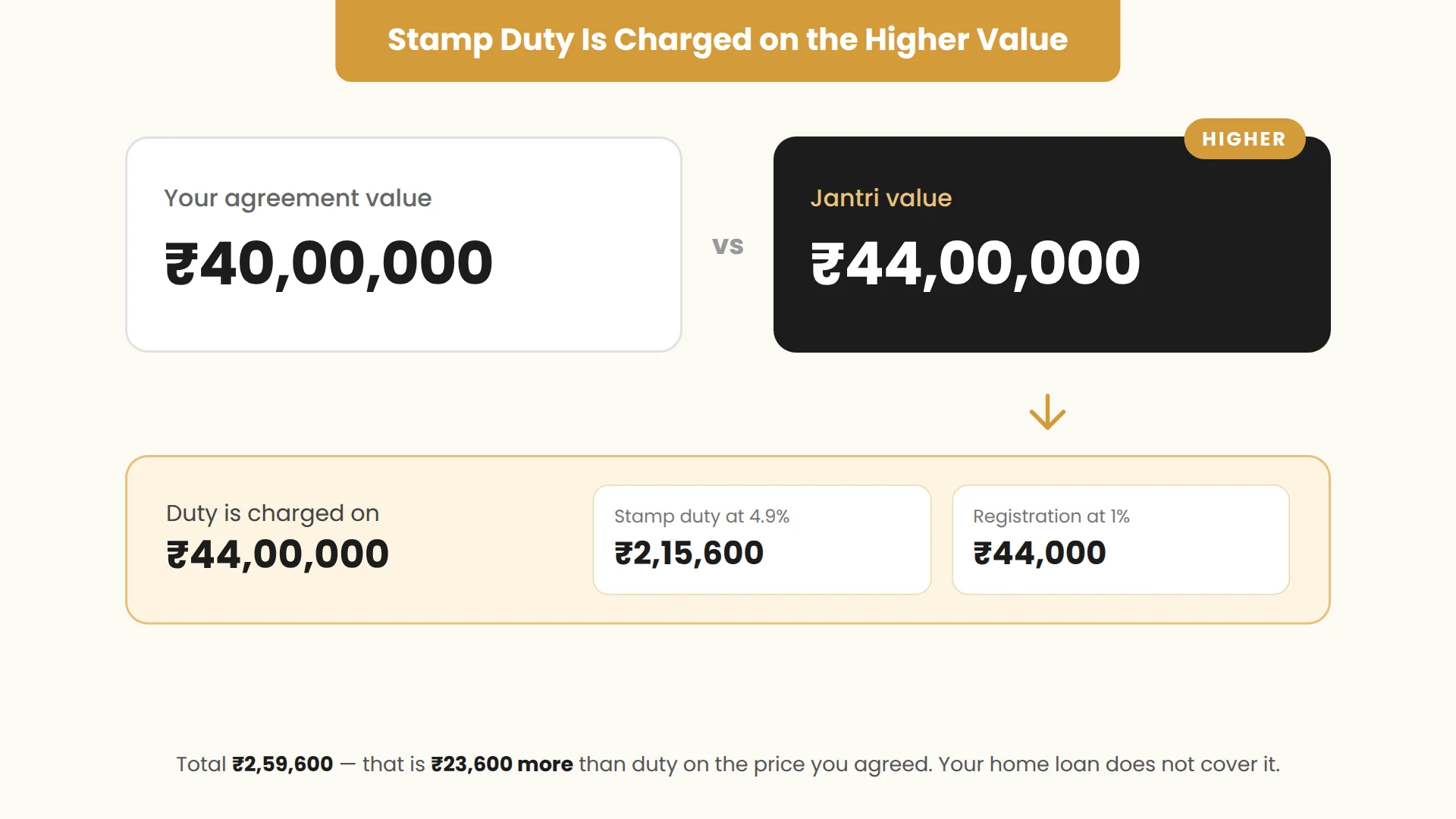
Say you agree ₹40,00,000 for a flat. You budget duty on ₹40 lakh. But when the sub-registrar works out the jantri value for that flat, it comes to ₹44,00,000.
| Duty on your price (₹40 lakh) | Duty on the jantri value (₹44 lakh) | |
|---|---|---|
| Stamp duty at 4.9% | ₹1,96,000 | ₹2,15,600 |
| Registration at 1% | ₹40,000 | ₹44,000 |
| Total | ₹2,36,000 | ₹2,59,600 |
The gap is ₹23,600. That is not a rounding error on a ₹40 lakh budget, and it lands at the worst possible moment — because your home loan does not cover stamp duty or registration. Banks lend against the property value; these charges come out of your own pocket, in cash, on the day.
Which is the whole reason to look the number up before you sign anything, not after. If you are mapping out the rest of the day-one cash, our guide to the hidden costs of buying a flat in Ahmedabad covers the charges that sit alongside these, and the EMI calculator handles the loan side.
Jantri Rate vs Market Price
These are two different numbers and they answer two different questions.
| Jantri value | Market price | |
|---|---|---|
| Who sets it | The Gujarat Revenue Department | Buyers and sellers |
| What it is for | A floor for calculating stamp duty | What the flat actually sells for |
| How often it changes | Rarely — it sat unchanged from 2011 to 2023 | Continuously |
| Which is usually higher | Lower, in most established areas | Higher |
Because it is revised so rarely, jantri drifts behind the market between revisions — then jumps when a revision lands. That is exactly what happened in 2023.
There is one case where jantri comes out higher: a plot or flat in an area the market has moved away from, or a deal priced unusually low. Then it becomes your tax base, and the duty goes up even though the price did not. For what homes are actually selling for across the city, see our guide to property prices in Ahmedabad.
Are New Jantri Rates Coming in Gujarat?
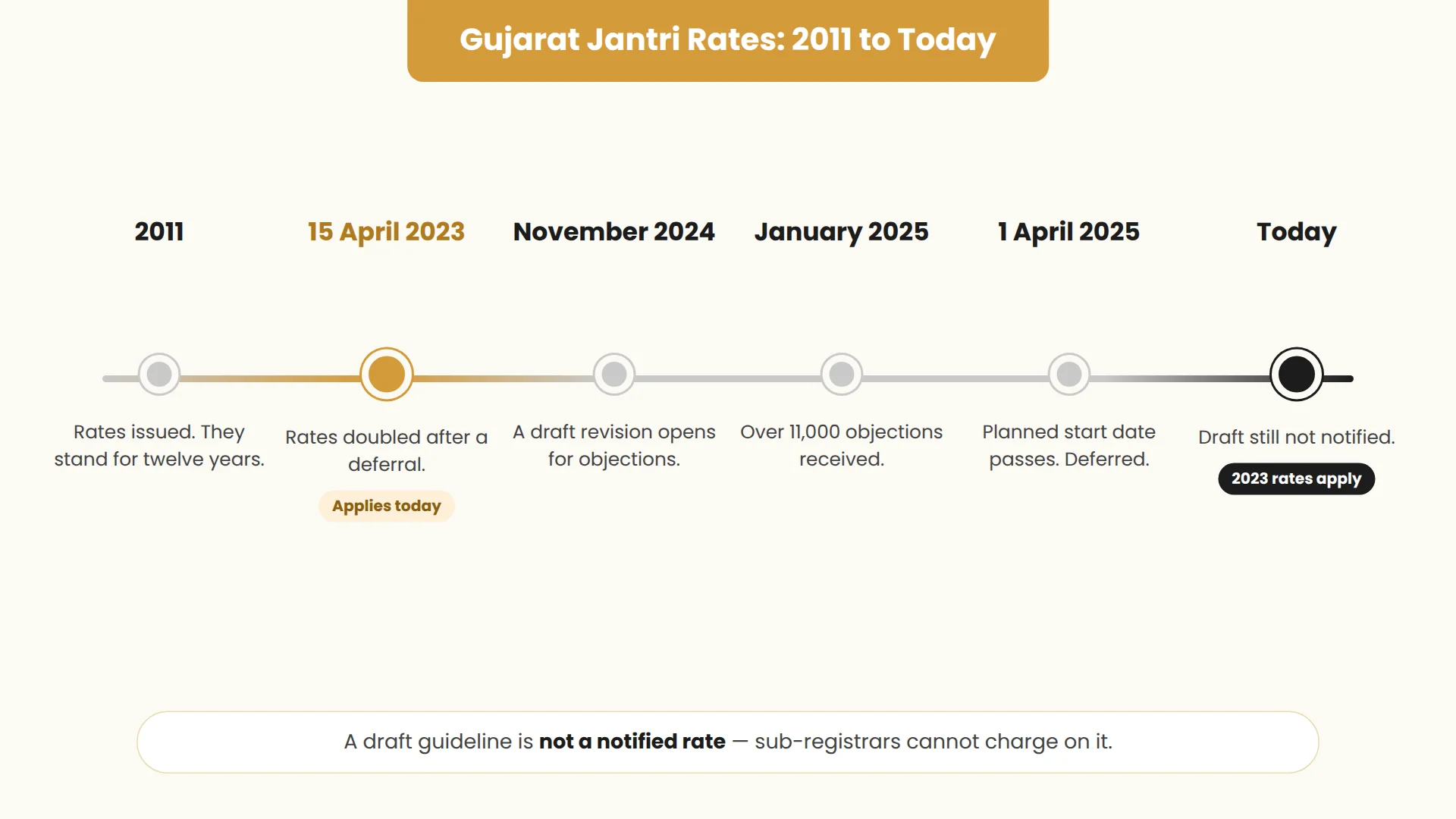
A revision has been drafted, but it is not in force. As of October 2026 the rates notified on 15 April 2023 are still the ones you pay on. Here is how that happened.
| When | What happened |
|---|---|
| 2011 | The Annual Statement of Rates is issued. These rates stand for twelve years. |
| February 2023 | The state announces a 100% increase — a doubling — citing rapid industrial and urban growth. |
| 15 April 2023 | The doubled rates take effect after a deferral. These apply today. |
| November 2024 | A draft revision for 2024 is published and the public is invited to object, with a window to 20 December. |
| January 2025 | More than 11,000 objections and suggestions are received. Most — 6,753 — ask for rates to be reduced. CREDAI Gujarat submits memorandums against the proposal. |
| 1 April 2025 | The planned start date passes. Implementation is deferred. |
| Today | Still not notified. A phased rollout is expected. The 2023 rates continue to apply. |
You can see the draft for yourself: the GARVI home page still carries a link reading “Guideline for Draft Jantri – 2024”. A draft guideline is not a notified rate, and sub-registrars cannot charge on it.
What This Means If You Are Buying Now
- Budget on today’s rates, which means the April 2023 jantri. That is what you will be charged.
- Do not rush a purchase on the basis that rates are about to jump. The revision has already slipped once by more than a year, and nobody outside the Revenue Department knows the final numbers.
- Re-check close to registration if your purchase runs over several months. A notification can land between your booking and your registration date.
Checking the Jantri Rate on a Laxmi Group Project
Everything above applies to any property in Gujarat. Since we build in Ahmedabad, here is how it works on ours.
Start with the part that matters most. Ask us for the survey or TP/FP number, and we will give it to you. It is public information, it is printed on the documents you will sign anyway, and you need it to run the lookup yourself. Our own guide to stamp duty in Gujarat says that a builder who will not share it is a warning sign. We would rather you checked than took our word for it.
Laxmi Group builds in three parts of the city, and each sits under a different authority on GARVI. Use this to pick the right taluka entry at step 3.
| Project | Where | Status | Taluka entry to try |
|---|---|---|---|
| Laxmi Nivas | Narol | Ready to move | AMC, else DASKROI |
| Laxmi Aashiyana | Narol | Ready to move | AMC, else DASKROI |
| Laxmi Eternia | Narol | Ready to move | AMC, else DASKROI |
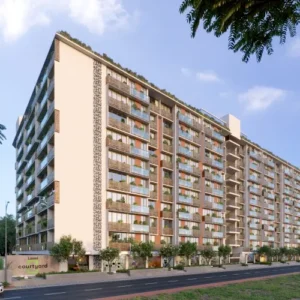
| Laxmi Courtyard | Narol | Under construction, possession 2029 | AMC, else DASKROI |
| Laxmi Skycity | Nava Naroda | Ready to move | AMC, else AHMEDABAD CITY |
| The Universe | Naroda, S.P. Ring Road | Under construction | AMC, else AHMEDABAD CITY |
| Laxmi One O1 | Bhadaj, Science City | Under construction, possession 2028 | AUDA - TP, else AUDA - REVENUE |
Two things worth knowing before you run the numbers on any of these. A ready-to-move home has its building-use permission already, so there is no GST on it — but stamp duty and registration still apply, and they are still charged on the higher of the two values. And the 1% registration fee is waived in full if the sole buyer is a woman, on a ready home or an under-construction one alike.
Know What Your Flat Will Actually Cost to Register
Laxmi Group has been building in Ahmedabad for over fifteen years, across Narol, Naroda and Science City. Tell us which home you are looking at and we will walk you through the duty, the registration fee and the day-one cash — before you commit to anything.
Frequently Asked Questions
What is a jantri rate?
A jantri rate is the Gujarat government’s minimum official value for a property, formally called the Annual Statement of Rates. Stamp duty and registration are charged on the higher of that value or your agreement price. Other states call the same thing a circle rate or ready reckoner rate.
How can I check my jantri rate online in Gujarat?
Go to the GARVI portal at garvi.gujarat.gov.in and click View MarketValue under Important Links. Choose your district, taluka and village, say how the land is recorded, pick the property type, enter the area and building details, then click Show MarketValue. You will need your survey or TP/FP number. It is free and needs no login.
How is jantri value calculated?
The portal takes the notified rate per square metre for your survey number and applies it to your area, then adjusts for the property type, the construction stage, whether the building has a lift, whether the flat is on the top floor, and the year it was built. That is why two flats in one building can carry different values.
What is the stamp duty rate in Gujarat in 2026?
Stamp duty is 4.9% and the registration fee is 1%, both charged on the higher of the jantri value or the agreement value. The registration fee is waived entirely when the sole buyer is a woman, though not on a joint purchase. See our full stamp duty guide for the rupee tables.
Where can I download the Gujarat jantri rates PDF?
The GARVI portal hosts rate documents by district, and the Revenue Department site links to them as well. For an actual purchase, use the online lookup rather than a PDF — the PDF gives you an area rate, while the lookup gives you the figure for your specific property after the floor, lift and construction adjustments.
Have new jantri rates been implemented in Gujarat?
No. A draft was published in November 2024 and drew more than 11,000 objections. It was due to start on 1 April 2025 and was deferred. As of October 2026 it has still not been notified, so the rates that took effect on 15 April 2023 are what you pay on.
What happens if I buy below the jantri value?
Stamp duty and registration are still charged on the jantri value, not on what you paid. So the tax does not fall with the price. Such a sale can also draw questions from the sub-registrar, and there are income-tax consequences for both sides, so take professional advice before agreeing to one.
Is the jantri rate the same as the market price?
No. Jantri is a tax floor set by the government and revised rarely. Market price is what buyers actually pay and moves continuously. In most established parts of Ahmedabad the market price sits above it, which is why duty is usually charged on the agreement price.
Do I pay stamp duty on the jantri value or the agreement value?
On whichever is higher. If your agreement price is above the jantri value, duty is charged on your price. If it is below, duty is charged on that instead.

Jayesh Shah
Jayesh Shah is the Managing Director & Chairman of Laxmi Group (Laxmi Goldorna House Ltd), an NSE-listed Ahmedabad real-estate developer that over 15+ years has delivered 5+ million sq ft and homes to 3,116 families across the city.
Sources
- GARVI portal, Inspector General of Registration, Government of Gujarat — the jantri lookup, the draft jantri 2024 guideline, and the portal fields described above. Walked through on 24 October 2026.
- Revenue Department, Government of Gujarat — Annual Statement of Rates.
- Gujarat government announcement of the 100% jantri revision, February 2023, effective 15 April 2023.
- Reporting on the draft jantri 2024 consultation and the 11,000+ objections received, January 2025.
Rates and the status of the draft revision were correct on 24 October 2026. Jantri values differ by survey number — always confirm your own on the GARVI portal before you budget. This article is general information, not legal or tax advice.